Ovens tend to quit at the worst moment: holiday week, a birthday cake in the pan, a casserole half done. One call to our dispatch line reaches a licensed, insured independent oven technician around Fargo.
Oven heating with the controls off? Turn off the oven breaker right away. A relay welded shut on the control board can keep an element powered even when the display says off, and that is a fire risk, not a waiting problem. For a gas oven with any smell of gas, leave the home and call the gas utility or 911 from outside first, then call us.
Why use our line
Why Callers Choose Our Network for Oven Repair in Fargo, ND
Most oven failures trace back to a handful of parts, but picking the wrong one wastes money and a second visit. The pros in our network diagnose the cavity before they quote.
Licensed and insured independent pros
The contractors on our referral line each run a licensed, insured business of their own. Feel free to ask for their paperwork when they arrive at your door.
Upfront written quotes from the pro
Expect a written quote after testing and before any repair. If the oven is old enough that replacement makes more sense, a straight-talking pro will say so.
Rapid local dispatch
We search the local schedule while you stay on the line. When a nearby pro has a gap, same-day service happens often, and the dispatcher confirms the window before the call ends.
Oven tools and trade knowledge
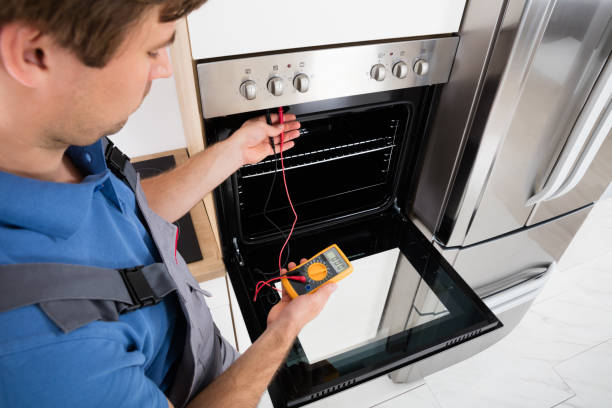
Oven work calls for a clamp meter to read igniter amperage, a multimeter for sensors and elements, a thermocouple probe to verify cavity temperature, and the wiring diagram from the tech sheet. An ESD strap protects the control board during handling.
Ranges, wall ovens and everything between
Single wall ovens, stacked double ovens, range ovens, steam ovens and speed ovens all come across our phones. Each one heats a box with a few key parts, and a good technician knows which to test first.
It helps to note the exact display code, like F1 or F3, and whether bake, broil or both have stopped. The model tag is usually on the oven frame just inside the door.
Inside the cavity
Oven Problems the Pros Diagnose and Fix
From weak igniters to stuck door locks, here is what independent oven technicians handle every week.
Electric ovens
Bake and Broil Elements
If the bottom coil has a visible break or the oven only heats from the top, the bake element is the usual suspect. Hidden elements under a smooth floor panel need the floor pulled, which the pro handles during the visit.
Element resistance and ground test
Hidden bake element access and swap
Broil element and terminal check
Gas ovens
Bake and Broil Igniters
A gas oven glow bar can glow orange and still be too weak to open the safety valve. The pro clamps an amp meter on the igniter circuit and compares the draw to the valve spec; a weak igniter is the most common reason a gas oven will not light.
Igniter amperage draw test
Gas safety valve check
Broil igniter diagnosis
Temperature
Sensor, Calibration and Hot or Cold Ovens
Recipes failing at the right setting point to the oven sensor or the control. The technician reads the RTD resistance, runs the oven with a thermocouple probe in the center rack, and adjusts the temperature offset if the hardware tests good.
RTD sensor resistance test
Thermocouple probe temperature check
Calibration and offset adjustment
Self-clean
Door Locks and Thermal Fuses
Ovens often fail during or right after self-clean. The lock motor can jam with the door shut, or the thermal fuse can blow and kill power to the whole oven. The pro tests the motor, the switch and the fuse before quoting.
Door lock motor and switch test
Releasing a door stuck locked
Thermal fuse and wiring check
Convection
Convection Fan and Element
Noise from the back wall or uneven browning in convection mode points to the fan motor or the ring element around it. The pro checks motor windings and element continuity with the panel off.
Fan motor winding and bearing check
Convection element continuity
Fan blade and rear panel inspection
Controls and door
Control Boards, F-Codes, Hinges and Gaskets
The technician reads the fault code, checks the relay outputs and wiring, and only replaces the board when tests point there. Door hinges and the fiberglass or silicone gasket are inspected too, since a poor seal wastes heat.
Fault code and relay output testing
Control or relay board replacement
Door hinge and gasket replacement
Read the signs
Oven Symptoms and Likely Causes
Match what you see to the list below before you call. The technician still tests to confirm, but this helps the dispatcher brief the pro.
Symptom
Common cause
What the tech checks
Gas oven glows but never lights
Weak bake igniter
Igniter amp draw against valve spec
Electric oven heats from top only
Burned bake element
Element resistance and visual damage
Food burns or stays raw at set temp
RTD sensor or calibration off
Sensor ohms, probe reading, offset
Door stuck locked after self-clean
Lock motor or lock switch
Motor operation and switch signals
Oven dead after self-clean
Blown thermal fuse
Fuse continuity and wiring
F-code on the display
Sensor, lock or control board fault
Code chart in the tech sheet
The process
Four Steps to a Working Oven
Here is how a call to our line turns into a heating oven again.
Call Dispatch
Start with a call. Share the brand, the fuel type and the symptoms, and our dispatcher matches you with a local oven technician who has time available.
Rapid Mobile Arrival
A local technician travels to your kitchen with oven parts on the truck. You hear the expected window during the call, and same-day appointments happen often when schedules allow.
Expert Assessment and Quote
After measuring the failed circuit, the pro explains it in plain words and writes a quote. You decide whether to repair, wait for a part, or think about a new oven.
Fix Completed and Tested
With the new part installed, the oven runs a full bake cycle while the technician watches the probe reading climb to temperature. Ask for the warranty terms on paper.
Holiday and big-dinner emergencies
The busiest days on our line come right before holidays, when ovens that have been limping along finally quit. If yours died the day before a big dinner, call early in the day; local pros fill their schedules fast in holiday weeks.
A door that stays locked after self-clean is not a crowbar job. Wait for the cavity to cool completely, then let a pro free the lock mechanism and find out why it stuck.
Oven gone cold?
The line is answered 24 hours a day, including holidays.
Two days before a holiday dinner our oven glowed orange and never caught. The technician tested the igniter with a clamp meter, explained the valve needs a certain draw, and replaced it the same morning.
Patricia L.Homeowner, Fargo
After a self-clean cycle the door latch stayed shut. The technician found a failed lock motor, swapped it along with the switch, and walked me through why the cycle is so hard on those parts.
Kevin O.Homeowner, Fargo
Everything I baked came out scorched on the edges. The pro measured the real temperature with a probe, tested the RTD sensor, and replaced it when the reading came back wrong. Baking is back to normal.
Yolanda F.Home baker, Fargo
Our double wall oven lost power to the top cavity right after cleaning. The technician traced it to the thermal fuse, swapped it, and looked over the wiring around it before signing off.
Samuel H.Homeowner, Fargo, ND
Oven FAQ
Common Oven Repair Questions
Why does my gas oven igniter glow but the oven never lights?
A glowing igniter is not always a working igniter. The safety valve opens only when the igniter reaches a set amperage, and worn glow bars fall short. The technician measures the draw and replaces the igniter if it is weak.
How do I know if my oven temperature sensor is bad?
If the oven runs hot or cold, the sensor is high on the list. The technician checks its resistance with a multimeter and verifies the true cavity temperature with a thermocouple probe before replacing it.
My oven door is stuck locked after self-clean. What should I do?
Do not pry the door. Allow full cooling, cut and restore power once, and if the lock still holds, call. The pro can free the latch and replace the lock motor or switch that stuck.
Why did my oven stop working completely after a self-clean cycle?
The high heat of self-clean is hard on parts. A thermal fuse often trips to protect the oven, leaving it dead. The pro checks the fuse, the wiring near the vent and the board, in that order.
What does an F-code on my oven display mean?
F-codes are fault codes from the electronic control. They can point to a sensor, a door lock, a key panel or the board itself. The meaning varies by brand, so the technician reads it against the tech sheet for your model.
Is it worth repairing a wall oven or should I replace it?
Wall ovens are built into cabinetry, so replacing one can mean cutting or matching openings. Repairing elements, igniters, sensors and locks usually makes sense. The technician gives a written quote so you can compare.
Where we dispatch
Oven Repair Service Area Around Fargo
Oven calls reach us from every part of Fargo and the towns nearby. We look for the closest independent technician with an opening, whether you live in a high-rise unit or a house on a long gravel drive.
Property managers and landlords call too, since a tenant without a working oven is a tenant calling every hour. Give the dispatcher the unit number and the best contact for entry.
Zip codes covered around Fargo: 58102 58104 58103 58105 58106 58107 58108 58109 58121 58122 58124 58125 58126
Get dinner back on schedule
Bake, broil, convection or self-clean: call and we will find a local pro.